What it is, in one paragraph
AI-powered transcreation is adapting marketing copy for a specific market with AI, so it has the same effect on local readers as the original, even when the words change. Unlike AI translation, it doesn’t stop at a correct version: it checks the copy against your brand terms, your voice and the market’s conventions, and revises it until it reads as if it were written there. The best setups add a professional linguist before anything goes live.
At Ready-to-Publish Translations, we’ve adapted marketing copy for enterprise clients since 2016, and in 2026 we built Transcreate AI to do this at the speed marketing teams need. Here’s how it works, when it’s the right choice, and what to look for in a tool.
How it differs from AI translation and traditional transcreation
- AI translation carries meaning from one language to another, quickly and usually accurately. It works sentence by sentence and doesn’t know your brand, your audience or the ad slot the copy has to fit.
- Traditional transcreation is done by a copywriter in the target market. It gives the best creative results, but it’s slow, hard to scale across many markets, and quality depends on the brief each writer receives.
- AI-powered transcreation sits between the two. AI drafts copy for a specific market, using your brand assets, then checks and revises it against clear criteria. A human linguist reviews what will be published.
How AI-powered transcreation works
Here’s the process in Transcreate AI. Other tools differ in the details, but a good workflow covers the same ground.
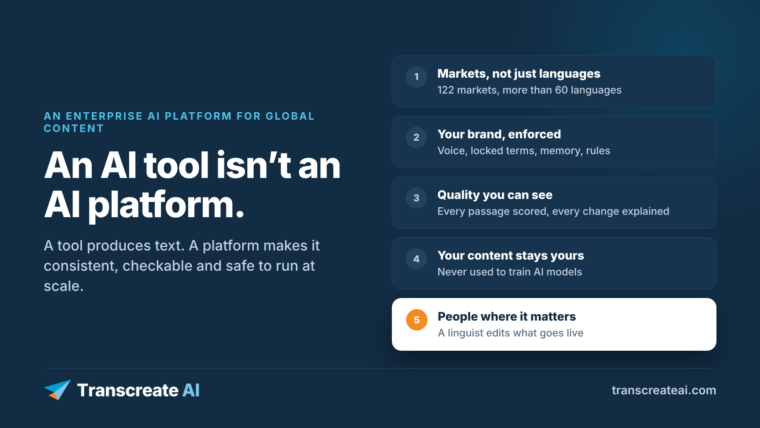
- Brief by market, not language. You choose the markets, such as Spanish for Mexico or Arabic for the Gulf, not just “Spanish” or “Arabic.” Transcreate AI supports 122 markets across more than 60 languages.
- Load your brand assets. Your glossary, your translation memory (imported as TMX from Trados, memoQ or Phrase, or as CSV and Excel), your brand voice and your quality rules. These come before any creative choice.
- Read the source as a marketer would. The AI identifies what each passage is meant to do (persuade, reassure, create urgency) and what has to stay fixed: brand names and locked terms.
- Adapt for the market. It writes copy that does the same job for local readers, adjusting idioms, tone, cultural references, currency, dates and formatting.
- Critique and revise. A second AI agent scores each passage on meaning, brand voice, terminology, local conventions and fluency. Anything below 9/10 goes back for revision. Brand names, locked terms and platform character limits are checked mechanically, and the reasoning behind each change is shown.
- Offer a second version. For transcreation jobs, you get a second, genuinely different version of each asset, ready for A/B testing.
- Return the file, formatted. Word, PowerPoint, PDF, Excel, subtitles, app strings or HTML emails come back in their original format, right to left for Arabic, Hebrew, Persian and Urdu.
- Human review. A professional linguist does a full editing pass, and in-market colleagues can approve the copy through a secure link, no account needed.
When to use it
- Campaigns running in several markets at once, where a copywriter per market would be too slow or too expensive.
- High-volume marketing content: ads, email campaigns, landing pages, product pages, app store listings, social posts.
- Content with hard limits: ad headlines, push notifications and app store fields, where the copy has to fit as well as persuade.
- Brands with established assets: a glossary, a translation memory and a clear voice give the AI the most to work with.
When something else is a better fit
- Contracts, manuals and specs: accuracy is the whole job, so translation, with human review, is the right tool.
- A flagship tagline or a brand launch: start with AI for options, but give a senior copywriter in the market the final word.
- Regulated claims: financial, health and legal copy can be transcreated, but final copy should always be signed off by the client’s compliance team.
What to look for in an AI-powered transcreation tool
- Markets, not just languages. Can you choose Spanish for Mexico, and not just “Spanish”?
- Your brand assets first. Can you import your glossary and translation memory, and are locked terms checked on every job?
- A visible quality bar. Is each passage scored, and what happens when it falls short?
- Explained changes. Can you see why the copy changed, so your team can review it quickly?
- Your files back, formatted. Does a PowerPoint come back as a PowerPoint, layout included?
- Human review built in. Who does it, and is it a full edit or just a sign-off?
- Data privacy. Is your content used to train AI models? With Transcreate AI, it never is.
Frequently asked questions
Is AI-powered transcreation the same as machine translation? No. Machine translation carries meaning across languages. AI-powered transcreation adapts the copy for a market, checks it against your brand and the market’s conventions, and revises it until it reads as if it were written there.
Can AI really transcreate marketing copy? It can produce strong, market-ready drafts quickly, especially with your glossary, translation memory and voice loaded. For sensitive copy that will be published, we recommend a review by a professional linguist.
Does AI replace copywriters? No. It takes the repetitive work off their desk, so they spend their time on the calls that need a native ear: wordplay, tone and cultural fit.
How many languages does Transcreate AI support? 122 markets across more than 60 languages, including right-to-left languages such as Arabic, Hebrew, Persian and Urdu.
Try AI-powered transcreation on a real campaign
If you’re localizing campaigns across several markets, Transcreate AI’s pilot program is open to marketing and localization teams. Request a pilot seat, or get in touch with our team.
For a broader look at the options, read Translation, AI translation or transcreation? How to choose for marketing copy.